Generative AI in Test Automation: How Tenjin Is Shaping the Future of Intelligent QA
admin on 19 December, 2025 | No Comments
In the ever-advancing software development landscape the role of testing has always been crucial to deliver high-quality software. Organizations are facing immense pressure to meet the dynamic demands of the market while maintaining impeccable software standards. Traditional test design methods have often struggled to keep pace, hampered by time constraints, resource demands, and the need for extensive domain expertise. We are proud to introduce a groundbreaking solution: the Generative Artificial Intelligence (GenAI) driven test design generator platform, Tenjin. It combines innovation and precision to redefine industry standards and drive innovation forward.
Tenjin’s GenAI integration has the capabilities to elevate the testing process by automating the generation of comprehensive test cases from a variety of input requirement documents or using existing test design. Furthermore, it not only streamlines test case generation but also improves accuracy, coverage, and traceability, leading to significant improvements in efficiency and quality. By leveraging Tenjin GenAI approach to generate test scenarios and test cases, organizations can significantly enhance their testing processes and accelerate software delivery cycles. This can be explained as below:
GenAI Test Automation is your key to staying ahead in today’s competitive landscape; start today, stay ahead!
Why Generative AI is a Game-Changer in Test Automation
Traditional automation depends heavily on predefined scripts, manual test case creation, and continuous maintenance. Generative AI challenges this model by introducing autonomy, adaptability, and context awareness. Here’s how
AI-generated test cases:
Generative AI can analyze application workflows, user stories, and historical defects to automatically generate comprehensive test cases – reducing human effort by up to 80%.
For teams struggling with coverage, this is a breakthrough.
Self-healing test scripts:
One of the biggest challenges in test automation is flaky tests. A small UI change or updated locator can break hundreds of scripts. Generative AI intelligently detects such changes, updates scripts autonomously, and ensures continuity without manual intervention.
Natural-language automation:
With codeless test automation, teams can now simply describe what they want to test in natural language. The AI interprets the intent and instantly converts it into executable tests, making automation accessible to non-technical QA members.
Faster feedback loops:
Generative AI analyzes patterns and predicts high-risk modules before tests even run. This proactive intelligence helps teams focus on critical areas early and accelerates release cycles.
Leverage Tenjin’s Advanced Components and Features
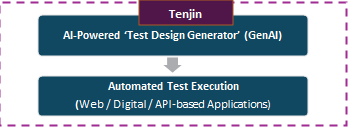
Tenjin is an advanced ‘codeless test automation’ platform that can seamlessly integrate with AI test design generator and allow the generated test design to be executed in any web/ digital device-based application. The test design phase harnesses the power of GenAI to meticulously design test scenarios and test cases, along with self-healing capabilities which ensure uninterrupted test execution cycles. The test execution in Tenjin gives the freedom to opt for either manual or automated test execution. Apart from this, it also comes with a host of features like defect tracking, project-level tracking features, and artefacts management.
The components and features of Tenjin can be summarized as below:
Unleash Efficiency & Accuracy with GenAI Test Automation
The journey towards innovation and adaptation for more efficient and effective testing practices led to integration of advanced Artificial Intelligence (AI) technology, commonly known as Generative AI. GenAI utilizes deep learning algorithm and natural language processing to generate highly effective test design. It further incorporates predictive analytics for optimized testing, intelligent execution, and defect analysis. This approach of GenAI in test automation can completely transform the software testing industry to a new level. The benefits of GenAI in test automation are listed below.
Benefits of GenAI in Test Automation
Generative Artificial Intelligence (GenAI) represents a groundbreaking advancement in test automation, offering unparalleled efficiency, adaptability, and scalability. By leveraging GenAI approach to generate test scenarios and test cases, testing processes can be significantly enhanced and software delivery cycles can be accelerated.
The need for Test Design Generator Platform
The shortage of proficient resources in coverage-based testing, coupled with the demand for domain expertise, poses a significant challenge. Organizations encounter growing difficulty in sourcing skilled personnel, and despite substantial investment, the creation of comprehensive test designs remains a slow process.
In response to these challenges, we leverage the advancements in AI and our decade of expertise in the testing arena to introduce the Test Design Generator in Tenjin. It is built upon finetuned large language models (LLMs), filled with extensive domain and testing knowledge across sectors. By automating the generation of test designs directly from input documents, our test automation tool addresses the prevalent issues in traditional test case creation.
Seamless GenAI Integration in Tenjin
Tenjin comes with GenAI capabilities for enhanced accuracy and efficiency. This revolutionary addition for test design & test prediction has the ability to generate test design with greater accuracy and efficiency like never before. Further, its self-healing capabilities driven by AI technology maintains a smooth flow of test automation in applications, even when there is a risk of breaking the existing test cases while making updates/ modifications in the application.
GenAI enabled Tenjin leverages Large Language Models (LLM), with current integration into external models such as GPT (Generative Pre-trained Transformer), and future to support all popular open AI models, along with an internal LLM supported AI model.
Transformative power of Tenjin: Test Design & Test Prediction
Test design is a critical part of the testing process that involves identifying test cases by analytically listing the steps necessary to execute the defined test conditions. The test design generation process by using Tenjin begins with the collection of input artefacts, primarily done by gathering the requirement documents like Business Requirement Documents (BRD), Functional Specification Documents (FSD), user stories, coverage metrics, and other relevant documentation. It has the ability to read all kinds of document formats like PDF, XLS, TXT, Docx etc., while supporting both structured and unstructured input documents. Optionally, Tenjin can also utilize its expansive test repository wherever required.
These inputs undergo processing within Large Language Models (LLM) in the GenAI processing models. The LLM employs advanced AI techniques to comprehend and analyze the input data, ultimately synthesizing a comprehensive and tailored test design. This process not only streamlines the test design phase but also ensures a more precise alignment with the specified requirements.
Integration with External LLM – GPT
Tenjin’s version with external LLM starts with the well-known GPT (Generative Pre-trained Transformer) model. This integration allows Tenjin users to harness the capabilities of GPT for improved test design automation. However, the Tenjin LLM integration model holds potential to support all AI models, providing users with a flexible selection of AI models to meet their specific needs.
Tenjin’s development of an internal AI model is to improve process customization and optimization, while guaranteeing excellence in test automation. By leveraging the power of Large Language Models, Tenjin ensures that test design aligns seamlessly with complex requirements, offering efficient test automation solutions. The new LLM integration with Tenjin allows the BFSI industry to not just efficiently but intelligently adapt to the ever-evolving technological landscape.
Elevate Performance with Tenjin’s GenAI
What makes Tenjin’s GenAI the most preferred choice for testing any software is the wide array of features it offers. One can leverage the remarkable features of Tenjin mentioned below:
Varied input documents:
One of the significant features of GenAI is its comprehensive support for various types of input documents. It seamlessly handles all kinds of input documents ranging from Business Requirements Documents (BRDs), Functional Specifications Documents (FSDs), user stories, to any other kind of documentation. This capability streamlines the testing process, enabling teams to effortlessly incorporate diverse sources of information into their testing protocols.
Ability to read different document types:
Tenjin GenAI boasts the ability to read different document types, including PDFs, Word Documents, Excel Sheets, and plain text files. This versatility ensures that teams can leverage existing documentation without the need for manual data entry or conversion, saving valuable time and resources.
Structured and unstructured input documents.
Tenjin supports structured and unstructured input documents. This flexibility enables teams to adapt to varying documentation formats and complexities, empowering them to tackle any testing challenge with ease.
Domain-free nature:
What truly sets GenAI apart is its domain-free nature. Unlike traditional testing solutions that are tailored to specific domains or functional modules, GenAI is agnostic to domain and software applications. Whether it’s Payments, Assets, Liabilities, Trade Finance, eCommerce, Education, or any other domain, GenAI can generate test designs effortlessly, making it a versatile solution for organizations across industries.
Context-based search capabilities:
Tenjin GenAI’s context-based search capabilities enable it to extract relevant information from documents, such as PDFs, with precision and accuracy. This functionality enhances the efficiency of the testing process, allowing teams to focus on critical areas without being drawn by irrelevant details.
SaaS and On-Premises models:
Tenjin offers deployment flexibility with support for both SaaS and On-Premises models. This adaptability ensures that organizations can choose the deployment option that best suits their needs and preferences, providing them with greater control over their testing environments.
Progressive and regressive options:
Tenjin empowers teams to generate test designs in progressive and regressive options, catering to diverse testing requirements and scenarios. This flexibility enables teams to optimize their testing strategies and adapt to evolving project needs seamlessly.
Conclusion
GenAI in test automation offers innovation, transformation, and limitless opportunity. By harnessing the power of artificial intelligence and machine learning, GenAI will play a central role in shaping the future of software quality assurance, driving greater efficiency, reliability, and user satisfaction in the digital age. To this trend, Tenjin’s GenAI integration represents a paradigm shift in the test automation sector. With its robust features, unmatched versatility, and commitment to innovation, Tenjin elevates the testing experience for organizations worldwide.