
Top 15 Test Automation Tools Every QA Team Should Know in 2026
admin on 10 March, 2026 | No Comments
Test automation tools play a crucial role in modern software development by enabling faster testing, improved quality, and continuous integration with DevOps workflows. Tools such as Selenium, Playwright, Cypress, and Appium remain widely used across industries.
For enterprise and BFSI organizations, adopting advanced automation platforms helps improve testing efficiency, ensure regulatory compliance, and deliver secure digital experiences.
Software development has become faster and more complex with the adoption of Agile, DevOps, and continuous delivery practices. Organizations must ensure that applications are reliable, secure, and high-performing while releasing new features rapidly.
Manual testing alone cannot meet these demands. This is why test automation tools are essential for modern QA teams. Automation tools help teams execute thousands of test cases quickly, improve test coverage, and reduce human errors.
In this guide, we explore the top 15 test automation tools in 2026 that every QA team should consider for building efficient testing strategies.
Why Test Automation Tools Are Important
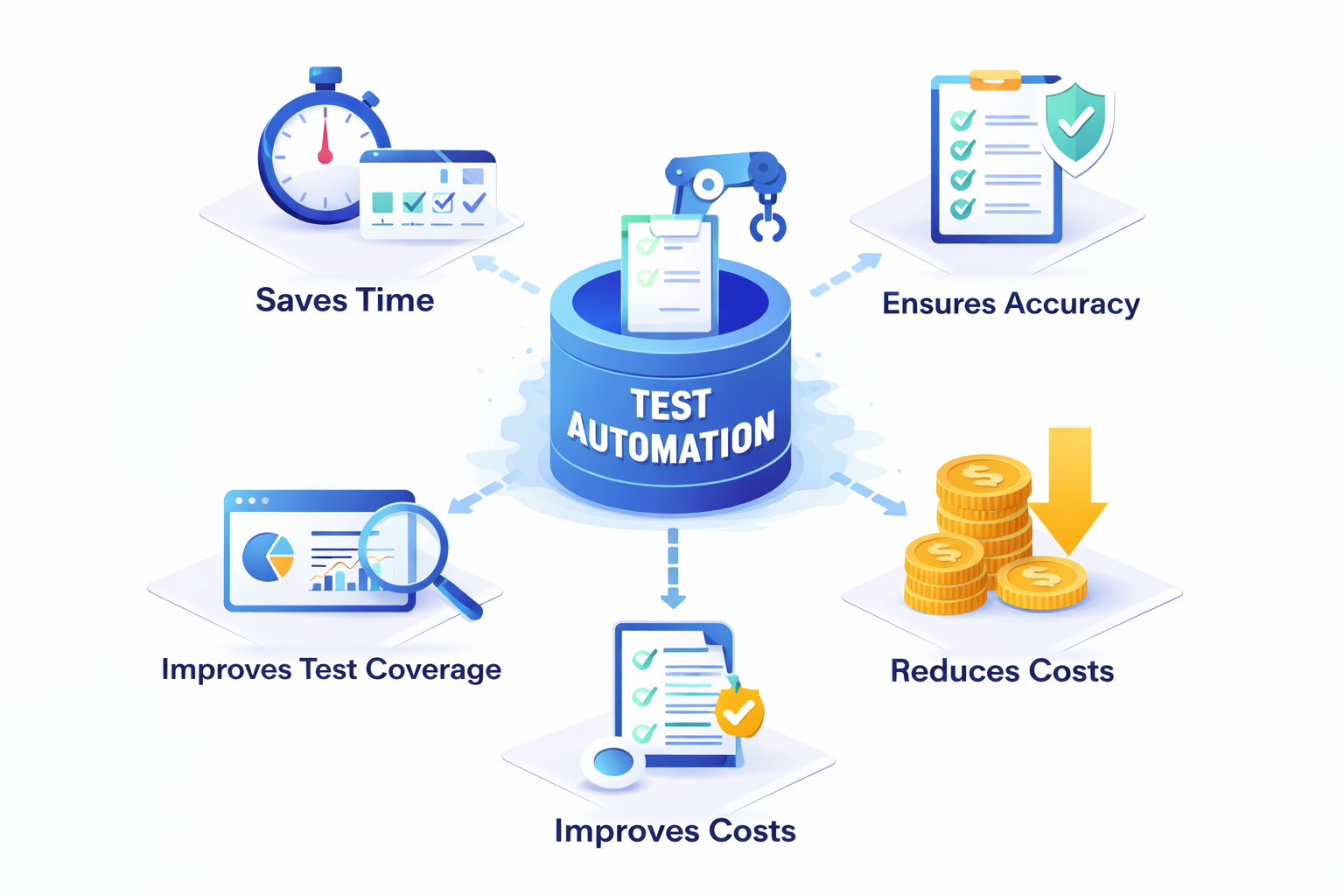
Test automation tools provide several advantages for software development teams:
- Faster test execution
- Improved software quality
- Continuous testing in CI/CD pipelines
- Higher test coverage
- Reduced manual effort
These benefits are especially critical for industries such as banking, fintech, healthcare, and enterprise SaaS platforms where software reliability is crucial.
Top 15 Test Automation Tools in 2026
Selenium
Selenium is one of the most widely used open-source tools for web automation testing.
Key Features
- Supports multiple programming languages
- Cross-browser testing
- Large developer community
- Integration with CI/CD tools
Playwright
Playwright is a modern testing framework designed for fast and reliable web automation.
Key Features
- Cross-browser testing
- Parallel execution
- Built-in API testing support
- Reliable test execution
Cypress
Cypress is a popular testing framework used primarily for front-end web testing.
Key Features
- Fast test execution
- Real-time reload
- Built-in debugging tools
- Easy setup
Appium
Appium is an open-source automation framework for mobile application testing.
Key Features
- Supports Android and iOS
- Cross-platform testing
- Compatible with multiple languages
Robot Framework
Robot Framework is an open-source automation framework that uses a keyword-driven testing approach.
Key Features
- Easy-to-read syntax
- Extensible libraries
- Strong community support
Katalon Platform
Katalon provides an integrated environment for web, API, and mobile testing.
Key Features
- Low-code automation
- Built-in reporting
- Integration with CI/CD pipelines
BrowserStack
BrowserStack provides cloud-based cross-browser testing infrastructure.
Key Features
- Real device testing
- Cross-browser compatibility testing
- Parallel testing capabilities
LambdaTest
LambdaTest is another cloud platform used for cross-browser automation testing.
Key Features
- Selenium grid in the cloud
- Supports multiple frameworks
- Real-time testing environment
TestComplete
TestComplete is a commercial automation tool designed for enterprise testing.
Key Features
- Scripted and scriptless testing
- AI-powered object recognition
- Enterprise integrations
Tricentis Tosca
Tosca is widely used in enterprise environments for model-based testing.
Key Features
- Risk-based testing
- End-to-end automation
- Enterprise integration support
Ranorex Studio
Ranorex provides automation solutions for desktop, web, and mobile applications.
Key Features
- Record-and-playback testing
- Powerful IDE
- Easy object identification
Postman
Postman is a popular tool for API testing and automation.
Key Features
- API test automation
- Collaboration tools
- API monitoring
SoapUI
SoapUI is a functional testing tool designed for testing APIs.
Key Features
- REST and SOAP testing
- Security testing
- Load testing
Puppeteer
Puppeteer is a Node.js library used for browser automation and testing.
Key Features
- Headless browser automation
- Performance testing capabilities
- Screenshot and PDF generation
Cucumber
Cucumber supports Behavior Driven Development (BDD) testing.
Key Features
- Human-readable test scenarios
- Collaboration between developers and testers
- Integration with automation frameworks
Test Automation in BFSI Applications
The BFSI industry requires highly reliable testing processes due to the complexity of financial systems.
Banking applications include:
- Core banking systems
- Payment processing platforms
- Digital banking applications
- Fraud detection systems
Automated testing helps ensure:
- Secure financial transactions
- Regulatory compliance
- Reliable customer experiences
AI-driven platforms such as Tenjin Online help enterprises automate testing across web, mobile, API, and database layers while reducing testing time and improving software quality.
How to Choose the Right Test Automation Tool
Before selecting an automation tool, consider the following factors:
Application Type – Web, mobile, or API testing.
Integration Capabilities – CI/CD pipeline compatibility.
Scalability – Ability to support enterprise-level testing.
Ease of Use – Learning curve for QA teams.
Maintenance Requirements – Long-term test maintenance.
Selecting the right tool helps organizations build scalable automation frameworks and improve release efficiency.
The Future of Test Automation
The testing landscape is rapidly evolving with new technologies such as:
- AI-driven test automation
- Self-healing test scripts
- Low-code and no-code testing platforms
- Autonomous testing frameworks
These innovations will help QA teams accelerate software delivery while maintaining high quality standards.

Related Topics
- Reliable Test Automation Strategy
- Test Automation Maintenance Guide
- Test Automation Best Practices
- AI-Powered Test Automation
FAQs
What are test automation tools?
Which test automation tool is best in 2026?
Why is automation testing important?
What industries benefit most from test automation?
Which test automation tool is best for beginners?

Experience Intelligent Testing with Tenjin
Turn plain English into automated tests in seconds
Start Free Trial Request a Demo